Sunday, February 19, 2012

Double Standard

I’ll admit it, I’m an Apple fan; but I’m no fanboy. Apple has and does disappoint me in many ways, and I’m not afraid to admit it. But often I feel that at least some of my disappointment stems from the fact that my expectations are just so darn high. When Apple does things well, it’s spectacular, so when one of their products is merely good or, rarely, mediocre, it’s normal—though perhaps not entirely fair—to feel betrayed.

However Apple’s critics are another matter indeed. Something about Apple attracts the sort of hostility—stoked to a white-hot hatred by the company’s skyrocketing success of late—that no other company I can think of must endure. Maybe it’s a necessary balance to the absolute devotion of a certain type of Apple lover.

But what I find frustrating about the coverage of Apple by tech journalists is the double standard that is so often applied. Take for instance the “controversy” over the recently announced Gatekeeper function of Apple’s forthcoming OS X update, Mountain Lion. Gatekeeper offers users three security settings for downloading software. The most secure setting limits you to applications from Apple’s App Store. A middle ground lets you download apps outside the App Store as long as they are from “identified developers” (with developer certification being free of charge). And a third option allows you to download apps from anywhere, with no restrictions. 

I think it’s quite an elegant solution that provides an extra layer of security for those who want it but still gives those who wish to download “unapproved” apps the freedom to do so. So I was dismayed to hear certain prominent tech journalists (Tom Merritt, for instance, in the TNT podcast), rather than praising Apple for working to make its OS more secure, instead musing that they hoped this wasn’t the start a slippery slope toward Apple locking down the Mac OS completely in the future. Seriously?

A few years ago, tech journalists were all over Apple because of Safari's default setting to automatically open “safe” files, such as pictures and movies, after downloading (I'm not sure if this is still the case). They were right to do so; this was a highly insecure default setting. If Apple is deserving of criticism, I’ll gladly lead the charge, and in matters of security, the criticism has often been deserved. Which is why it’s so maddening when Apple gets bad press for doing something right in security! 

I’ll give Merritt the benefit of the doubt, since he often plays devil’s advocate. But really, why does the role of devil’s advocate even need to be played in this case? Because of something Apple might do? In the unlikely event that Apple were to lock down OS X to limit where users can download apps from, it would surely bring the mother of all firestorms of criticism down on its head, and rightly so. But until that happens, why not offer praise where praise is due? 

The obvious answer is that tech journalists are under so much pressure to not look like fanboys that they bend over backwards to be objective, even when that “objectivity” creates a double standard. 

With all of Apple’s recent success, I suppose its a problem a lot of other companies would love to have. 

From The Doghouse Diaries


Wednesday, February 15, 2012

CBC Music


When the CBC “revamped” its daytime programming in 2008, the move was almost universally panned among musicians and music lovers. The organization’s once proud and robust tradition of excellent classical and jazz programming was decimated, and excellent, dynamic radio hosts found themselves replaced by glorified DJs spinning an insipid lineup. No longer able to stomach this new programming, I found myself increasingly listening to my own classical iTunes library on shuffle or to online classical streaming radio stations. 

Although the CBC did have a few online streaming stations, they were quite limited and very broad. So I was pleased and surprised to see the CBC finally launch a digital music service on Monday, along with an iOS app: CBC Music

The new website and app have 40 different streaming channels, including 10 classical channels alone, and five jazz channels. For the last three afternoons, I’ve had the Baroque channel playing over my home stereo via the AirTunes link built into the iOS app (even after over a year of this feature’s release, I still find it somewhat magical to stream music from my iPod right to my stereo). It’s a testament to the quality of the music on the channel that I’ve only wanted to skip a couple of tracks so far. For the most part, the ensembles are all excellent, and there’s a decent variety. My only real complaint here is that it’s very heavily weighted toward instrumental music (in three days of listening, I have only heard one vocal track). In fact, I had assumed that it was instrumental only until I finally heard Karina Gauvin and Nicole Lemieux singing a Handel duet. I’m not sure why this should be, since there’s such a vast choice of vocal Baroque repertoire to choose from. Maybe it’s a licensing issue, but I hope they can change this. To be fair, the site seems to be in beta, which would indicate that they are still ironing out the bugs

I haven’t tried any of the other channels, but I’m very pleased with the Baroque channel. Every half an hour or so, there’s a promotional tag for the service, and this makes it less suitable for things like dinner parties, where it’s nice to have some music playing in the background. I have a few iTunes playlists I use for this, but I’d be happy to use CBC Music, especially since it means I get to listen to new music too, not just my guests. That said, I’ll admit that it’s a minor quibble for a free service.

The website itself works reasonably well, though I didn’t find it particularly intuitive to set up an account. Some of the social networking features either don’t work with Safari or Chrome (the two browsers I use), or they require you to enable popups. The CBC goes so far as to plead that these are problems with other sites such as Facebook, but frankly I find this a lame excuse. Even when I switched to FireFox to test it, I couldn’t for the life of me figure out how to enable the “Add to favourites” and “Share this track” buttons. And the “Add to playlist” button doesn’t seem to work, even though it isn’t greyed out. Kind of frustrating. Granted, it’s a new service, but I hope they squash these bugs soon. One nice thing is that you don’t have to create an account to use the service, though I believe you do have be have a Canadian IP address.


The iOS app does what it says on the box. It’s a very simple interface for surfing the various channels, and that’s about it. You can’t login to your CBC Music account, and you can’t use any of the social networking features (not that I seem to be able to use them on the website anyway). Which is all fine; I like simple. I imagine that a future update will add social networking features, and hopefully better implemented than on the website. 

I do have a few items on my wish list for both the site and the app. First, a “skip” button. There seems to be one on the site, but it’s greyed out. Not sure what that’s all about. But the only control on the iOS app is a volume slider. As I said, the music selection is really quite good, so a skip button isn’t essential, but it would be nice.

Another feature that’s lacking is a link to iTunes so that I can buy a track if I like it. I’m pretty sure this would be easy enough to implement, so I’m not sure what’s holding the CBC back. Even something as simple as “search for this song on the iTunes store” would be fine.

I also wish there was some sort of notification system for the app, so that when my iPod screen locks, I could have a notification appear showing the track information, rather than having to unlock the screen every time I hear a track for which I want to know the title or artist.

But these quibbles aside, I like the service and the app. I think I’ll use the app more often just because it’s easier to stream it to my home stereo, but either way, for the first time since “the change,” classical music lovers can go to the CBC and find great music whenever they like. CBC radio is still a disaster, but radio is a dying medium anyway.


Tuesday, January 17, 2012

I CAN'T HEAR YOU!


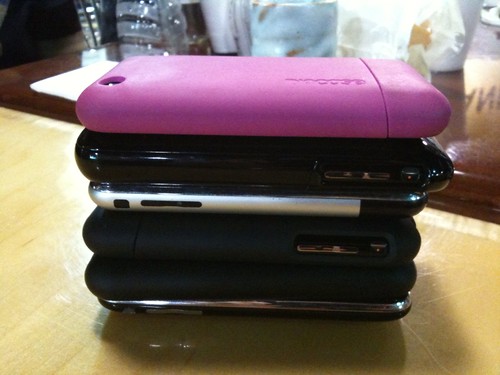
Nerd phone stack at dinner
Photo Credit: Kate Hartman (http://www.flickr.com/photos/katehartman)
This morning, I was perusing my Twitter feed and saw that Stephen Fry had tweeted a link to a Yahoo News story about a new phenomenon called the Phone Stack Game. The premise is that when you go out to dinner with friends, everyone puts their phone in the middle of the table (in a stack, one presumes) and the first one who gives in to the temptation of checking email or text messages or perhaps even taking a phone call (do people still actually call each other?) picks up the tab for dinner. This apparently makes the dinner more “civilized.”

While this is fine as trends go—and I’m all for people turning off their phones at dinner and other social gatherings, such as symphony concerts—I can’t help but feel that there is still a significant portion of the population who have it in for the poor old mobile phone.

Not that I am such a huge fan of the things (heck, I’m still using an ancient Sony-Ericsson slider phone), but let’s face it, they’re here to stay, and I think eventually our social norms will evolve so that they will be more accepted. This is already old news among young people. They don’t seem to have any qualms about checking their phones and socializing at the same time. Indeed, for teens, the two appear to be one and the same thing. So I think anyone younger than 20 would probably view the Phone Stack Game as rather quaint.

To me the bigger problem is the “loud talking” phenomenon. I’m sure you know what I’m talking about. Whether in restaurants, on airplanes, or in quiet places like museums—in fact, just about anywhere—loud talkers are incredibly annoying. They cheerfully blather away at 110 decibels, oblivious to the rattling window panes and bloodied eardrums they leave in their wakes. In fact, the only thing worse than a loud talker is a loud talker on the phone, and this is where I think the mobile phone gets a much worse rap than it deserves. 

I’m not sure why this is, but it seems to be a universal human phenomenon that when we are speaking to someone who is not in the room with us, whether it’s on the phone or on Skype, we tend to speak louder. Perhaps because the other person is not right next to us, we feel on some subconscious level that it’s as though they were in the next room, and hence we need to raise our voice to be heard. 

So forget the Phone Stack Game, here’s one bit of cell-phone etiquette that I wish were more common: When you’re on the phone, just speak normally! There’s no need to shout; the other party will hear you just fine, and you’ll avoid so many dirty looks. In exchange, I’d let you use your phone at the dinner table and not make you pick up the tab.

Monday, January 09, 2012

The mythical Apple Television -- doomed to failure? Of course it is.


Even though Apple hasn’t attended the Consumer Electronics Show for years, it always seems to capture a lot of the show’s buzz, either by holding an event of its own around the same time, as it often did when it was involved with the Macworld exhibition, or, more recently, courtesy of the ever-churning Apple rumour mill. 

This year is no different. With Steve Jobs’ revelation in Walter Isaacson’s biography that he had “cracked it,” in reference to making an easy-to-use TV, CES is (or apparently will be) abuzz over when Apple will release its long-rumoured television.

Count me among those who think Apple will eventually release a television, but I don't think it will be this year; my gut tells me we’ll have to wait until 2013. I think it will simply take that long for Apple to work the (sometimes serious) kinks out of iCloud and Siri. 

That said, I have a bone to pick with the many pundits I hear, especially on the various tech podcasts I listen to, saying that an Apple-branded television is a ridiculous idea. Their arguments go along the lines that since Apple is a high-margin company, their TVs will be over-priced and doomed to fail because people traditionally don’t buy new TVs at the same rate they buy new computers or phones. Who would spend thousands and thousands of dollars on a new TV, knowing that it will be obsolete in a few years? The answer to this rhetorical question is, of course, no one. Hence the “doomed to failure” part. Every time I hear this, it sets my teeth on edge.

Apple has never entered a market only to compete on the existing playing field. With the iMac, iPod, iPhone, and iPad, it either totally disrupted the market or, in the case of the iPad, conjured it out of thin air. With so many precedents in its history, why do all these pundits think Apple would just make an over-priced TV to compete with Samsung, Toshiba and Sony. 

I haven’t the foggiest idea what the Apple TV will be like, but if Steve Jobs and Apple "cracked it," I’d be willing to bet that a) it’s drop-dead gorgeous, b) it won’t be as expensive as everyone is expecting (remember the gasps of surprise when Steve introduced the iPad starting at $499), and c) it will be a game changer. 

Somehow, I doubt many of the “pundits” will be willing to take my bet.

Wednesday, January 04, 2012

iPod nano 6th Gen


Wow. Has it really been over two years since I posted here? I suppose it’s time for an update. In fact it’s quite likely that updates will be forthcoming somewhat more regularly, since I plan to blog more frequently this year as part of my “Resolution 2012” project. So watch this space (if you dare). 

Back in the early days of this blog, I talked about my purchase of a red iPod nano 2nd Gen. At the time, I thought it was one of the most lickable pieces of technology I’d ever owned. Apple is so good at making the old hardware look dated, but looking back objectively, the 1st Gen nano, especially the black model, was even more beautiful—classic in its beauty. I bought one for my wife back in the day, and while it was soon relegated to a drawer, I’ve always admired its sheer elegance. Five years ago, iPods were still somewhat of a luxury item, and that 1st Gen nano had luxury written all over it.

So I was a little sad when Apple recalled those 1st Gen nanos because of a battery issue. But I dutifully sent it back, hoping that Apple would fix it and send back the same model, but not really thinking they would. As expected, when the package came in the mail a few weeks ago, my wife’s beautiful 1st Gen nano was nowhere to be found. In its place was a new 6th Gen iPod—beautiful in its way, but not at all the same thing.

But hey, it’s smaller than the old iPod, and it has four times the capacity and a nifty touch screen. Cool as that is, though, I wasn’t sure what to do with it. Both my wife and I have iPod touches now, mine a 64 GB model, so space was not an issue. I certainly didn’t want to relegate a brand new iPod to the junk drawer, so I decided on a whim to try it out as my workout iPod. 

I’ve recently taken to listening to podcasts again while running or walking, so I just synced it to my podcast folder in iTunes and off I went. Almost immediately I noticed some advantages of the nano over the iTouch. First, you can set the sleep/wake button to act as a play/pause button when you double-click it (the double-click can also be set to skip to the next track if you so prefer). Just that one thing—a hardware play/pause button—makes it a better workout device than the Touch. Also, because it’s wearable, I’ve taken to using it around the house (that hardware play/pause button still comes in handy), where I was previously using bluetooth headphones with my Touch. The hardware volume buttons on the nano are also nicer, it seems to me, than the ones on the Touch. The nano’s weight is also an advantage. While the Touch isn’t exactly heavy, if you happen to drop it while wearing wired earbuds, you’ll experience—as I have done on several occasions—the nasty sensation of having them ripped out of your ears as the whole unit falls to the floor. With the nano, if for any reason it slips out of your hands, it’s light enough that it simply dangles there from your ears. No harm done. 

So I must say that though I’m a little sad that my wife’s old nano is gone, I’m quite pleased that we have been upgraded after four years. This new nano has actually become my iPod of choice for around the house. The only drawback is that it doesn’t have bluetooth, but I’d be willing to make a small wager that that feature will be part of the 7th Gen nano. 

Good on you Apple. Even though the nano is probably not a huge money earner for the company compared with the iPhone or even the iPod Touch, it’s still a great little device. If you’re looking for a workout iPod, I highly recommend it.

Wednesday, September 30, 2009

An iTunes 9 annoyance

With the latest version of Apple's erstwhile music playing app--now the 800 MB do-it-all gorilla known as iTunes 9--came a total revamp of the iTunes store. And while there's no denying it's prettier, it has also introduced an annoyance that I can no longer overlook.

Take a look at this screenshot (click to enlarge):


Notice anything odd? Yep. All the album names are truncated. I know that there's an album with some Rachmaninoff and that it's probably related to the piano rather than the greek letter pi, but I have no other immediate visual information about the album. Hovering my mouse over the album does nothing. Clicking the "i" information button brings up a pop-up that tells me this album is entitled "Rachmaninoff plays Ra..."


Excuse me, but WTF? I had no idea that the Egyptian sun god wrote piano music. OK, my incredulity is forced. You get my point. But at least the track names are all there, you say. And yes, it's true. In this preview window, the track names are all present and accounted for in full. So why then, if I click the "Album Page" link to see the recording's dedicated page, am I presented with this:

While I finally get to see what the full album title is, now all the track titles are truncated. I have to hover the pointer over the track name to see it in full. It's as if iTunes is some sort of control freak who doesn't want you to know too much lest it feel it's loosing control of the situation.

The worst thing is, there's no way to expand the track name (or any other) field, so in this case, I can't find out the full artist name (Zenph Studios and Serg...) unless I preview the track and look in the iTunes display window (Zenph Studios and Sergei Rachmaninoff). Sure seems like a lot of work to find information that's on the cover of any CD. (Incidentally, don't you think it's noble of Sergei to let the studio take first billing; I guess it's easy to be magnanimous when you're dead.)

So yeah, the new iTunes store is pretty, but at least the old one had some substance. I logged a feedback note with Apple about this issue, but I must say crappy UI design is pretty rare in an Apple product. All the more reason why when something like this does get into a release, its so startling.

Wednesday, September 23, 2009

Two weeks with Google Quick Search Box

Quicksilver, I'm sorry, but barring a miracle, you're dead to me. After installing Snow Leopard a few weeks back, I upgraded to QS B56a7. The good news: it works; the bad news: it hogs 100 percent of my MacBook Pro's CPU. So, er, no.

Hence, it's back to Google Quick Search Box. And to be honest, I'm pretty happy with it. It works well, and after setting it up to use the same launch key combo that I used for QS, I hardly notice the difference. It lets me mount and eject disk images with a few keystrokes, just like QS.  I've even managed to assign the same Command-esc shortcut to send a file (not a folder though) to QSB. Unfortunately, once there, QSB can't do anything useful with it yet. QS would let you email it or move it or make an alias of it somewhere. These are functions I would really like to see in QSB soon.

In the meantime, I'm trying to figure out how to use Automator and Snow Leopard's revamped Services menu to bridge the functionality gap between the two apps. But I'm an Automator novice and it's slow going. One thing is sure: QSB is winning over my heart.